How Long Will Your Chinese Apartment Really Last?
Have you ever wondered how long the house you spent your whole life buying can actually last? People with no social experience would say '70 years', because that's what the contract for Chinese commercial housing says. People with some social experience would say '50 years', because they know that with the current quality and structure of Chinese houses, '50 years' is already exceeding expectations. And those who have truly experienced the pain and suffering will tell you, after living in a house for ten to fifteen years, you will face the crisis of having to move. Why is that? Today, I will reveal the dilemma behind high-rise residential buildings and tell you the way to avoid this crisis.
If you have been abroad and visited many countries, you will suddenly realize that it is rare to see clusters of high-rise residential buildings like China's in other countries. Of course, I'm not saying that there are no tall buildings abroad. There are many tall buildings in countries like the United States, New York, and Japan, Tokyo, which are not inferior to China's Beijing, Shanghai, Guangzhou, and Shenzhen in terms of the scale of the city or the number of skyscrapers. However, what sets them apart from us is that their tall buildings are mostly office buildings and commercial buildings, and there are very few residential buildings with more than 30 floors like ours.
Having high-rise residential buildings is not a bad thing, but China's situation is very special. Let me give you some data to make it clear. The United States is the world's fastest developing developed country, and its GDP has reached ten trillion US dollars, which took a whole 31 years. In contrast, China only took 14 years, less than half the time of the United States. If a country's GDP is growing, it is highly likely that its price level will also rise. Twenty years ago, you could have breakfast for just fifty cents in many Chinese cities, but now you can't have a satisfying meal with five yuan. This is something that everyone can personally feel. Since prices are rising all over China, can the property fees of high-rise residential buildings also increase? The answer is not that easy.
Twenty years ago, in the early batch of commercial housing in Shenzhen, the monthly property fees were only one or two yuan, which was already considered high at that time when the average salary was less than 3,000 yuan. With property funds, you can hire well-known property companies to provide good living services for residents. After all, although you buy the house, you also need the greening, security, elevators, and recreational facilities in the community. Considering that twenty years ago, the monthly property fees of one or two yuan per square meter could afford a good property company. But as time goes by and the continuous depreciation of currency, this amount is becoming inadequate. Faced with this situation, there are generally only two ways out: one is to significantly increase the property fees and hire well-known property companies, and the other is to continue with the current property fees and hire lower-level property companies.
Unfortunately, in China, the majority of communities end up going down the second path. Due to a large number of owners refusing to accept an increase in property fees, the level of property companies can only be lowered. That's why there is a joke circulating online that when you bought the house, the security guard was a retired soldier, looking sharp and handsome. But after a few years, the security guard becomes a middle-aged man, and after ten years, the security guard becomes an old man with white hair. You dare not even say a word when passing by, afraid of scaring him with a heart attack. And it's not just the security guards, the lowering of the level of property companies has a comprehensive impact. For example, the greenery becomes overgrown, there are piles of garbage, the heating temperature doesn't meet the standard, public spaces are occupied, and the elevators frequently malfunction. In short, your living environment will continue to decline until one day it reaches your psychological bottom line and you make up your mind to solve this problem.
But sadly, even if you are determined to solve the problem, you may only find two ways out in the end: one is to hold a homeowners' meeting and change the property company, and the other is to move to another house. The first option has very few successful cases in China because a community can easily have 1,000 or 2,000 households, and to make repairs or change the property company using public maintenance funds, you need to establish a homeowners' committee, which requires successfully convening a homeowners' meeting with the participation of half of the owners, and after the committee is established, it still requires the agreement of two-thirds of the owners to make joint decisions. Historical experience tells us that the more people involved in something, the harder it is to reach a consensus. When you try to persuade your neighbors with hope, you will find that in this big world, there are all kinds of people - some are too lazy to care, some don't care about the greenery or dog poop, some keep their doors closed, some just don't want an increase in property fees, and so on. You can't even gather half of the owners, let alone discuss the next steps. Therefore, once high-rise residential buildings have been lived in for more than ten to fifteen years, the overall living environment will rapidly deteriorate, and rich people will choose to move to another house, while those who can't afford it will be forced to stay and endure it, eventually turning the community into a slum that everyone makes fun of.
Faced with this situation, do we have no solution? Of course not. To avoid the continuous deterioration of the community's environment, there are currently at least four ways out.
The first way out is direct reconstruction through shantytown renovation. This is the simplest and most direct solution, demolishing all old communities and building new ones on the same site, redistributing houses based on the number of households and area. However, this solution currently has problems. With the continuous increase in Chinese housing prices and the increase in the number of floors, the cost of shantytown renovation is increasing exponentially, and in a few years, it may become too expensive for the government to afford.
The second way out is the renovation of old communities, with the government subsidizing the greenery, wall structures, heating, and elevator equipment of the community. However, this solution currently has problems. For example, if a building is eight floors and needs to add an elevator, people living on the seventh and eighth floors will be happy, but those on the first and second floors won't care. If you ask them to contribute money, they will definitely oppose it, leading to strong resistance and ultimately nothing getting done.
The third way out is to set high property fees when selling houses. Many developers have already considered the inflation factor, and the property fees in some Shenzhen projects can be as high as ten yuan per square meter. Even if the currency depreciates in the future, such high property fees can support the community for a long time.
The fourth way out is government intervention in community management. The reason why community management is dirty, messy, and poor, and why proposals for property fee increases cannot be approved is due to the lack of an authoritative organization to coordinate. If we allocate property fees to the government's fiscal budget and have the government send personnel to manage the community, with every penny spent being transparent and public, even if the currency depreciates in the future and property fees are insufficient, all owners will be aware of the situation and can maximize the reduction of resistance to reasonable increases in property fees. This may be a more suitable approach for China's national conditions.
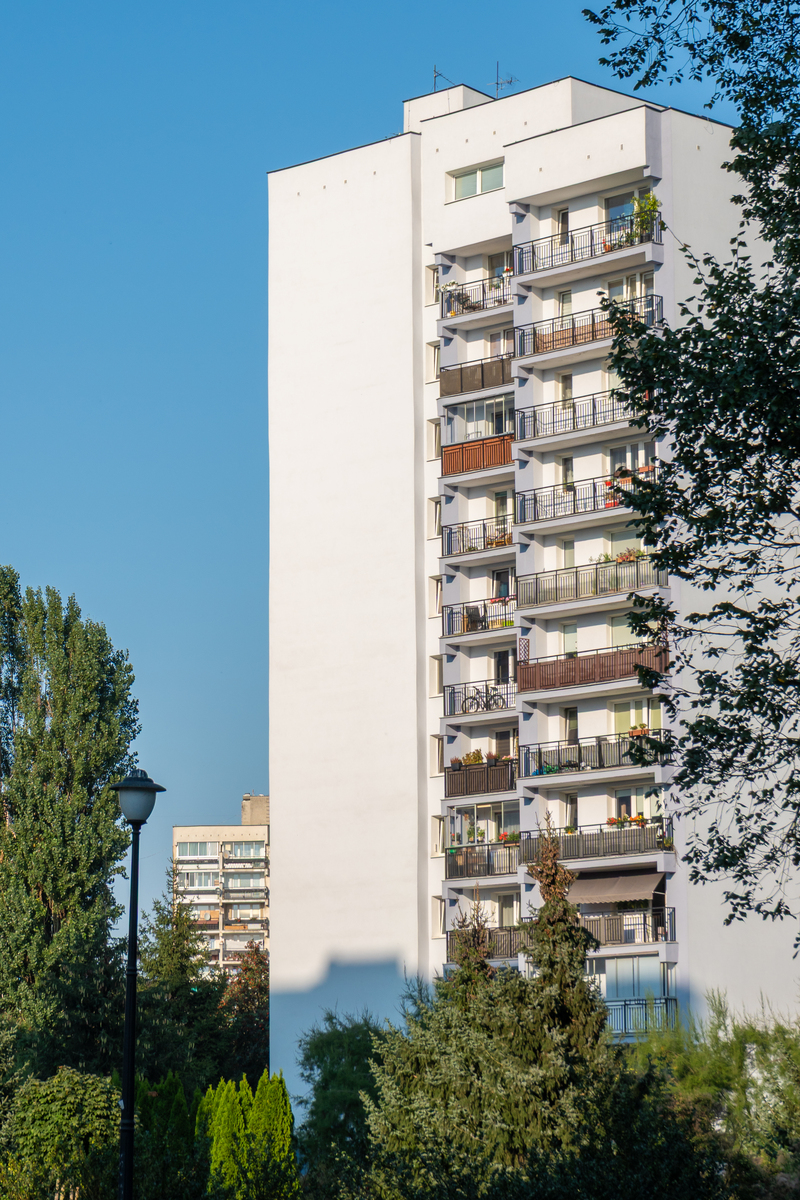
Now, China's urbanization rate has reached almost 70%. Most Chinese people live in high-rise residential buildings like this, and this is not a small problem.
原文地址: https://www.cveoy.top/t/topic/puU9 著作权归作者所有。请勿转载和采集!